
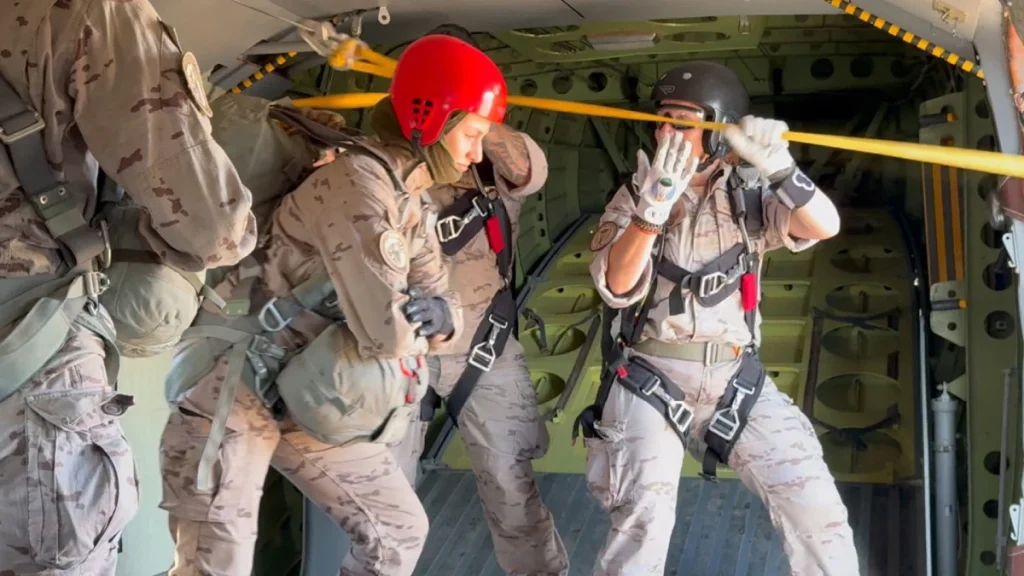
Princess Leonor of Spain has taken a bold step that blends tradition, duty and a modern vision of monarchy: she has completed basic parachute training at the Méndez Parada Military School in Murcia and become the first member of the Spanish royal family to earn an official parachutist qualification. The images and videos released by the Royal Household show a focused, composed young woman stepping out of a C‑212 Aviocar and floating down under canopy — a moment that will be remembered as much for its symbolism as for the physical feat itself.
What Leonor actually did
Over two intensive weeks in May, the princess underwent a rigorous program of physical tests, simulation exercises and tower jumps that prepared her for airborne operations. The training culminated in a jump from roughly 1,300 feet (about 400 metres) with automatic parachute deployment, and included the demanding scenario of a night jump. Throughout, Leonor trained alongside around fifty fellow cadets and completed the exercises required to obtain a formal parachutist qualification — a first for Spain’s royal family.
Why this matters: symbolism and preparation
Leonor’s decision to undertake parachute training is far from a mere public relations stunt. It is the culmination of a structured programme at the Air and Space Academy, designed to forge leadership through shared challenge and responsibility. In modern constitutional monarchies, heirs are expected to bridge ceremonial roles and civic leadership; military training — particularly a demanding course like this — conveys discipline, resilience and a willingness to share the burdens of service.
What this says about the new generation of royals
Across Europe we’re seeing heirs who combine academic studies, public duties and practical, sometimes military, training. Leonor’s path — military qualification followed by university studies in political science at Carlos III University in Getafe this autumn — reflects a dual model: the monarch as both a disciplined figure and an intellectually prepared statesperson. It’s a template that aims to resonate with citizens who value competence and authenticity over mere ceremony.
The public reaction: admiration with a thoughtful rhythm
Releases of photos and footage of the jump sparked admiration and even a touch of national pride. Yet commentators have also urged a measured view: the training is serious, but it is one element among many in Leonor’s preparation. Observers note the importance of balancing demanding military experiences with the princess’s forthcoming academic commitments and international engagements. For many, the overall impression is positive: a royal who embraces challenge and returns to civilian duties with a broader perspective.
What it means for women and role models
For young women in particular, Leonor’s achievement is a potent symbol: a visible role model who is not confined to traditional feminine roles, who can participate in demanding physical training and then move seamlessly into scholarly and civic pursuits. It encourages a broader vision of female strengths — physical endurance, technical skill and intellectual leadership — and helps normalize the idea that women can thrive in environments historically dominated by men.
Practical takeaways from Leonor’s example
Her journey offers useful lessons for our readers who want to cultivate resilience and purpose: commit to a demanding project that stretches you, combine physical discipline with mental study, and let public service be expressed through concrete action as well as ideas. Whether it’s taking a new professional challenge, training for a personal goal or returning to study, the blend of courage and preparation that Leonor embodies can be a powerful compass.
Leonor’s parachute qualification is a vivid moment in the story of modern monarchy: a youthful heir who literally leaps into duty, and who returns to civilian life — and soon to university — with new experience, credibility and a message that leadership today combines courage, discipline and study.